Understanding the evolution of SEO
Search engine optimization (SEO) has come a long way since the early 2000s. What started as a keyword-stuffing, backlink-hunting game has evolved into a complex, user-centered discipline.
Search engines like Google now prioritize relevance, authority, and usability—rewarding websites that serve users well over those that try to manipulate rankings.
With constant algorithm updates and a growing emphasis on content quality, businesses must adapt quickly. Enter artificial intelligence (AI)—a tool that can analyze massive amounts of data, suggest content improvements, and even generate content itself.
The question for small businesses now is: should you trust AI to drive your SEO strategy, or stick with traditional, human-powered methods?
CLICK HERE to Schedule Your Discovery Call With Samson Media!
What is AI-powered SEO?
AI-powered SEO uses machine learning tools and natural language processing to automate and enhance parts of the SEO process. These tools can:
- Analyze search trends and suggest high-performing keywords
- Evaluate competitor content and offer optimization suggestions
- Generate content outlines or even full drafts
- Predict what content is most likely to rank well based on intent and structure
Popular tools like Surfer SEO, Clearscope, Jasper, and ChatGPT allow marketers to accelerate content production, identify optimization gaps, and test various strategies at scale.
For small businesses, AI SEO tools can level the playing field by offering advanced insights without hiring a large team. They’re particularly helpful for:
- Fast keyword research
- Competitive content audits
- On-page SEO improvements (headings, metadata, keyword density)
But while AI tools can accelerate output, they don’t replace the need for strategic oversight.
What is traditional SEO?
Traditional SEO is built on manual strategies, intuition, and industry experience. It includes:
- In-depth keyword research using tools like Google Keyword Planner
- Writing original, high-quality content tailored to a target audience
- Building backlinks through relationships, guest posts, and PR
- Optimizing site structure, internal links, and technical performance
- Monitoring rankings, engagement, and conversions over time
Traditional SEO requires more time and human resources, but it also brings a deeper understanding of brand voice, customer behavior, and market positioning. It’s especially effective in:
- Niche markets where expertise and trust are paramount
- Industries with complex services that require accurate explanations
- Local SEO efforts that depend on reputation, reviews, and personalization
Key differences: AI vs. traditional SEO
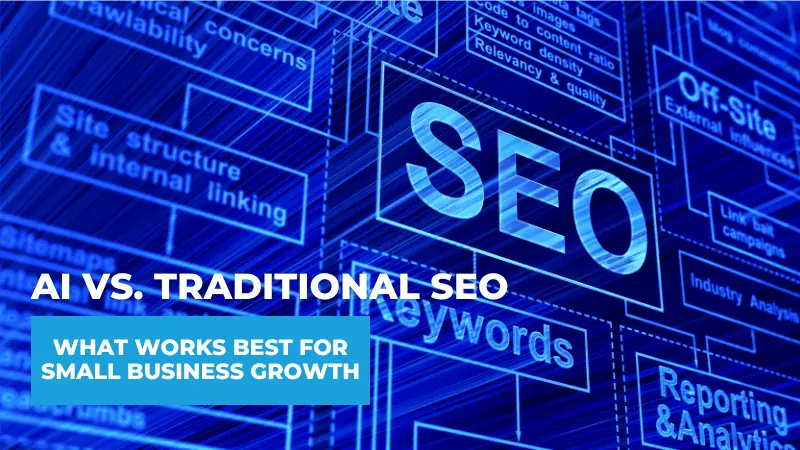
Let’s break down how these two approaches compare across core SEO components:
- Speed and efficiency: AI is faster. It can generate topic clusters, optimize existing pages, and build content briefs in minutes.
- Creativity and nuance: Traditional SEO relies on human storytelling, branding, and emotional resonance—things AI struggles with.
- Data handling: AI excels at parsing huge datasets to spot patterns traditional SEO teams might miss.
- User experience focus: Traditional SEO often better accounts for user journey, pain points, and design integration.
- Quality control: Human editing remains essential, as AI can produce errors, redundancy, or factually incorrect claims.
- Cost: AI tools are cost-effective upfront but may lead to long-term costs if misused. Traditional SEO is resource-heavy but typically delivers higher-quality output.
In reality, AI and traditional SEO aren’t mutually exclusive—they’re complementary.
What works best for small businesses?
For most small businesses, the best approach is a hybrid strategy that combines the speed and efficiency of AI with the judgment and creativity of human marketers.
Marketing agencies like Samson Media use AI tools to support content creation—but always with human direction. Before any content is produced, our team defines the goals, sets the SEO and brand parameters, and provides detailed prompts aligned with your business strategy. This ensures that every AI-assisted deliverable is accurate, engaging, and on-brand.
AI is used to:
- Suggest keywords and structure outlines based on current trends
- Streamline SEO audits and technical checks
- Generate first drafts that meet strategic goals
But human experts:
- Define the strategy and guide the AI
- Refine messaging, tone, and accuracy
- Ensure the final product reflects your business values and voice
This combination allows small businesses to:
- Maintain a consistent publishing schedule
- Optimize pages quickly with AI feedback
- Ensure messaging stays on-brand and audience-focused
For example, a small law firm might use AI to identify high-traffic keywords like “estate planning attorney near me” but rely on Samson Media to guide the structure, edit the output, and create a polished article that’s compliant, trustworthy, and strategically effective.
Common pitfalls of relying too heavily on AI
AI can be a powerful SEO assistant—but it’s not foolproof. Common mistakes include:
- Publishing unedited AI content: This can lead to bland, repetitive, or incorrect articles.
- Over-optimization: AI tools may focus too much on keyword density, hurting readability and triggering Google penalties.
- Ignoring user experience: AI can’t design user-friendly page layouts or understand visual hierarchy.
- Lack of originality: Without human oversight, AI content risks sounding generic and derivative.
To avoid these issues, always:
- Have a human editor review AI-generated content
- Focus on intent and reader needs, not just search engines
- Combine data-driven insights with brand tone and industry expertise
FAQ: AI and SEO for small business marketing
Can small businesses use AI for free?
Yes—tools like ChatGPT, Google Trends, and Ubersuggest offer free tiers that support basic SEO tasks.
Will AI replace SEO agencies?
Unlikely. AI can support agencies, but strategy, creativity, and campaign management still require humans.
What AI tools are worth the investment?
Popular tools include Surfer SEO, Clearscope, Jasper, Frase, and SEMrush. Each offers unique benefits depending on your goals.
Does Google penalize AI-generated content?
Google does not penalize AI content specifically, but it does penalize low-quality or unhelpful content—whether AI- or human-written.
Is AI content detectable by search engines?
Yes, tools exist to detect AI-generated writing, but what matters most to Google is quality, originality, and helpfulness.
Can AI improve local SEO?
Yes—AI can help optimize location-based keywords, create local landing pages, and audit local search rankings.
What’s the best AI + human combo for SEO?
Let AI handle data analysis and drafting support. Let humans take over for editing, branding, UX, and strategy.
How Samson Media integrates AI with proven SEO strategy
At Samson Media, we blend cutting-edge technology with nearly two decades of SEO experience. Our team uses select AI tools to enhance keyword research, analyze competitors, and streamline content workflows.
But every AI-supported recommendation is reviewed, refined, and implemented by real SEO strategists who understand your market, brand, and goals. We don’t rely on AI to replace thinking—we use it to accelerate results without compromising quality.
This hybrid model means:
- Faster content production with higher quality standards
- Smarter audits and optimizations grounded in human judgment
- A foundation-first strategy that aligns your website, content, and lead generation
Boost your rankings with a smart SEO strategy
Choosing between AI and traditional SEO doesn’t have to be either/or. With Samson Media, you get the best of both worlds—a tech-forward approach backed by real marketing expertise.
Schedule a free SEO consultation to discover how we can elevate your visibility, rankings, and results.